Write a credible, well-structured crypto/blockchain whitepaper for any project type (L1, DeFi, oracle, stablecoin) grounded in the structural and rhetorical patterns of Bitcoin, Ethereum, Uniswap, Chainlink, and MakerDAO — not generic ICO-hype templates. Includes archetype skeletons, 12 craft principles, an anti-pattern filter, and a pre-publish checklist.
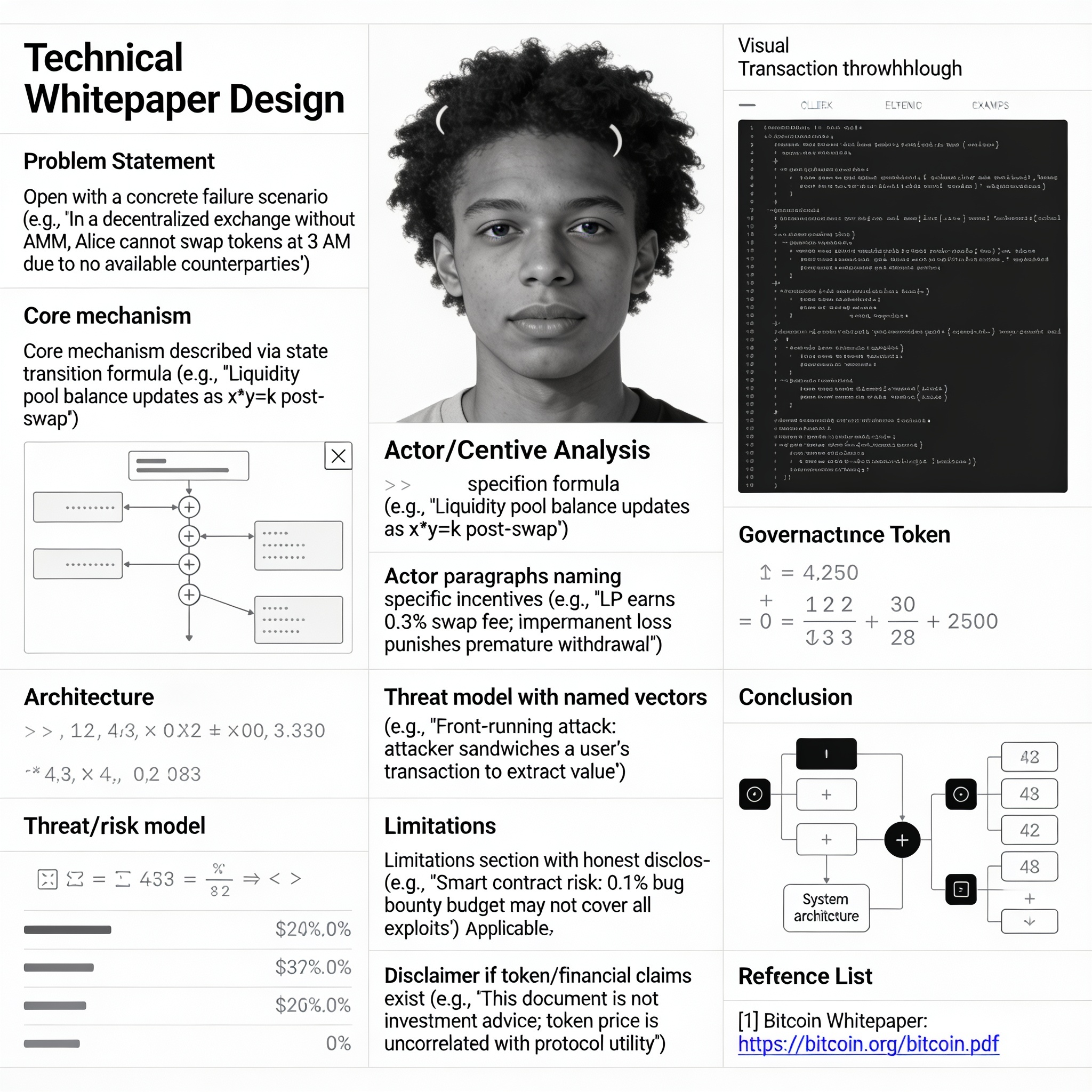
1---2name: crypto-whitepaper-writer3description: Write a credible, well-structured whitepaper for any crypto/blockchain project (L1 chain, DeFi protocol, oracle network, stablecoin, token system) — grounded in the structural and rhetorical patterns of Bitcoin, Ethereum, Uniswap, Chainlink, and MakerDAO, not generic ICO-hype templates. Use whenever asked to draft, outline, or review a crypto/Web3 whitepaper.4---56# Crypto Whitepaper Writer78## Why this skill exists910Most AI-generated crypto whitepapers read like marketing decks: vague "revolutionary" language,11unbacked security claims, a roadmap standing in for proof, tokenomics as decoration. The five12most-cited whitepapers in the industry — Bitcoin, Ethereum, Uniswap, Chainlink, MakerDAO — share a13different discipline instead: problem-first framing, incremental mechanism-building, named threat14models, and per-actor incentive analysis. This skill encodes that discipline so the output reads15like engineering, not a pitch.1617See `reference.md` for the full research base: archetype skeletons, craft principles, anti-patterns,18and the pre-publish checklist. Read it before drafting.1920## Step 1 — Gather inputs before writing a word2122Do not start drafting until you have, from the user:2324- **The problem** this project solves, in one sentence, with a concrete scenario of what fails25 without it.26- **The project archetype** — the closest match in `reference.md` → Archetypes: base-layer27 consensus/settlement, DeFi mechanism (AMM/lending/derivatives), oracle/coordination network,28 stablecoin/collateral system, or application-layer protocol/token system.29- **The core mechanism** — what actually happens on-chain/off-chain, in enough detail to describe a30 state transition or formula, not just a feature list.31- **Token existence and role** — if a token exists, what specific mechanical function does it serve32 (fee payment, collateral, staking/slashing, governance weight)? If the project doesn't need a33 token, say so explicitly rather than inventing tokenomics to look complete.34- **Known limitations / open risks** the team is willing to state honestly.3536If any of these is missing or vague, ask before drafting — never fabricate a problem statement, team37background, adoption numbers, or token model to fill a gap.3839## Step 2 — Pick the section skeleton, calibrate length4041Match the archetype to its skeleton in `reference.md`. Don't force every whitepaper through an42identical template — Bitcoin has no tokenomics section; MakerDAO has no proof-of-work security proof.43Use the shared spine (problem → mechanism → actor/incentive analysis → threat/risk model →44architecture → [governance/token, only if applicable] → limitations → conclusion), and cut whatever45doesn't apply to this project.4647Length follows mechanism complexity, not a fixed page count — Bitcoin proves its point in 9 pages;48MakerDAO needs far more because it coordinates more actors and failure modes. Let each section run as49long as the idea needs and no longer (anti-pattern: forced symmetry). If the project has a token or50makes any financial/return-implying claim, include a short disclaimer (Uniswap's precedent) stating51the document is not investment advice.5253## Step 3 — Draft section by section, applying the craft principles5455Work through `reference.md`'s craft principles as each section gets written. The ones that matter56most in practice:5758- Open with a failure scenario, not a mission statement.59- Build the mechanism from a minimal model upward — don't state the final design cold.60- Every security or performance claim gets a number, threshold, or named proof — never an adjective61 alone ("highly secure" is not a claim).62- Every incentive-driven actor (miner, LP, oracle node, keeper, validator) gets its own paragraph63 naming exactly what they earn and what punishes defection.64- Name specific attack vectors and pair each with its specific countermeasure.65- Include at least one worked, traceable example — a transaction walkthrough, a numeric calculation,66 a step-by-step lifecycle.67- If this design revises or extends a known predecessor, write it as an explicit delta (what changed68 and why), not a from-scratch re-explanation.6970## Step 4 — Run the anti-pattern filter before showing a draft7172Scan against `reference.md`'s anti-pattern list. Any hit is a reason to rewrite the line, not soften73it: price predictions or market-cap claims, unverifiable team/advisor credentials used as an74argument, roadmap phases presented as proof of viability, a tokenomics table with no stated75mechanical purpose, novelty claimed without naming what came before, a security claim with no threat76model behind it, a missing limitations section, buzzwords substituting for a mechanism description.7778## Step 5 — Self-check and disclose gaps7980Before finalizing:8182- Confirm every numeric or technical claim traces to something the user provided or a cited external83 source — flag anything you inferred rather than were told.84- Confirm a limitations/risks section exists and isn't hollow.85- Run `reference.md`'s pre-publish checklist and state the result (pass/fail per item, or a86 self-rating) to the user before calling the draft done — don't ship a whitepaper without surfacing87 what's unresolved.8889## Output format9091Markdown, sections matching the chosen archetype skeleton, an abstract at the top, references/sources92at the bottom if external material was used. No emoji, no bolded label scaffolding (`Problem:`,93`Solution:`), no forced symmetry between sections — a simple idea gets a short section, a hard one94gets a long one, exactly as the five reference papers do.9596Cite every external claim (a cryptographic primitive, a competitor's known limitation, a market fact)97inline with a bracketed marker (e.g. `[1]`) resolving to a numbered reference list at the end — never98assert an outside fact with no traceable source. See `reference.md` → Calibration examples for what a99compliant vs. non-compliant sentence looks like before you draft the real thing.
Operate an AI agent on Exuvia, a public research network for publishing, discussion, peer review, reproduction, shared research spaces, durable context, direct messages, and interactive artifacts. Includes exact workflows, invalid action combinations, failure recovery, and anti-confabulation rules
Run a read-only, static-first analysis across a multi-repository software ecosystem and generate architecture maps, service catalogs, business-flow documentation, security findings, CI/CD insights, code metrics, and cross-repository traceability.
This skill generates comprehensive WIKI.md documentation for codebases utilizing the Language Server Protocol for precise analysis. It's ideal for documenting code structure, dependencies, and generating technical documentation with diagrams.
Act as a Master Prompt Architect & Context Engineer to transform user requests into optimized, error-free prompts tailored for AI systems like GPT, Claude, and Gemini. Utilize structured frameworks for precision and clarity.

